Laplace transform converts a time domain function to s-domain function by integration from zero to infinity
of the time domain function, multiplied by e-st.
The Laplace transform is used to quickly find solutions for differential equations and integrals.
Derivation in the time domain is transformed to multiplication by s in the s-domain.
Integration in the time domain is transformed to division by s in the s-domain.
The Laplace transform is defined with the L{} operator:

The inverse Laplace transform can be calculated directly.
Usually the inverse transform is given from the transforms table.
| Function name | Time domain function | Laplace transform |
|---|---|---|
f (t) |
F(s) = L{f (t)} |
|
| Constant | 1 |  |
| Linear | t |  |
| Power | t n |
|
| Power | t a |
Γ(a+1) ⋅ s -(a+1) |
| Exponent | e at |
|
| Sine | sin at |
|
| Cosine | cos at |
|
| Hyperbolic sine |
sinh at |
|
| Hyperbolic cosine |
cosh at |
|
| Growing sine |
t sin at |
|
| Growing cosine |
t cos at |
|
| Decaying sine |
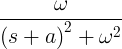
e -at sin ωt |
|
| Decaying cosine |
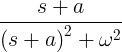
e -at cos ωt |
|
| Delta function |
δ(t) |
1 |
| Delayed delta |
δ(t-a) |
e-as |
| Property name | Time domain function | Laplace transform | Comment |
|---|---|---|---|
f (t) |
F(s) |
||
| Linearity | a f (t)+bg(t) | aF(s) + bG(s) | a,b are constant |
| Scale change | f (at) |
 |
a>0 |
| Shift | e-at f (t) | F(s + a) | |
| Delay | f (t-a) | e-asF(s) | |
| Derivation |
 |
sF(s) - f (0) | |
| N-th derivation |
 |
snf (s) - sn-1f (0) - sn-2f '(0)-...-f (n-1)(0) | |
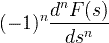
| Power | t n f (t) |
 |
|
| Integration |
 |
 |
|
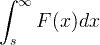
| Reciprocal |
 |
 |
|
| Convolution | f (t) * g (t) | F(s) ⋅ G(s) | * is the convolution operator |
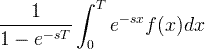
| Periodic function | f (t) = f (t+T) |
 |
Find the transform of f(t):
f (t) = 3t + 2t2
Solution:
ℒ{t} = 1/s2
ℒ{t2} = 2/s3
F(s) = ℒ{f (t)} = ℒ{3t + 2t2} = 3ℒ{t} + 2ℒ{t2} = 3/s2 + 4/s3
Find the inverse transform of F(s):
F(s) = 3 / (s2 + s - 6)
Solution:
In order to find the inverse transform, we need to change the s domain function to a simpler form:
F(s) = 3 / (s2 + s - 6) = 3 / [(s-2)(s+3)] = a / (s-2) + b / (s+3)
[a(s+3) + b(s-2)] / [(s-2)(s+3)] = 3 / [(s-2)(s+3)]
a(s+3) + b(s-2) = 3
To find a and b, we get 2 equations - one of the s coefficients and second of the rest:
(a+b)s + 3a-2b = 3
a+b = 0 , 3a-2b = 3
a = 3/5 , b = -3/5
F(s) = 3 / 5(s-2) - 3 / 5(s+3)
Now F(s) can be transformed easily by using the transforms table for exponent function:
f (t) = (3/5)e2t - (3/5)e-3t