Electrical voltage is defined as electric potential difference between two points of an electric field.
Using water pipe analogy, we can visualize the voltage as height difference that makes the water flow down.
V = φ2 - φ1
V is the voltage between point 2 and 1 in volts (V).
φ2 is the electric potential at point #2 in volts (V).
φ1 is the electric potential at point #1 in volts (V).
In an electrical circuit, the electrical voltage V in volts (V) is equal to the energy consumption E in joules (J)
divided by the electric charge Q in coulombs (C).

V is the voltage measured in volts (V)
E is the energy measured in joules (J)
Q is the electric charge measured in coulombs (C)
The total voltage of several voltage sources or voltage drops in series is their sum.
VT = V1 + V2 + V3 +...
VT - the equivalent voltage source or voltage drop in volts (V).
V1 - voltage source or voltage drop in volts (V).
V2 - voltage source or voltage drop in volts (V).
V3 - voltage source or voltage drop in volts (V).
Voltage sources or voltage drops in parallel have equal voltage.
VT = V1 = V2 = V3 =...
VT - the equivalent voltage source or voltage drop in volts (V).
V1 - voltage source or voltage drop in volts (V).
V2 - voltage source or voltage drop in volts (V).
V3 - voltage source or voltage drop in volts (V).
For electrical circuit with resistors (or other impedance) in series, the voltage drop Vi on resistor Ri is:
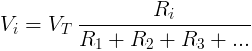
The sum of voltage drops at a current loop is zero.
∑ Vk = 0
Direct current (DC) is generated by a constant voltage source like a battery or DC voltage source.
The voltage drop on a resistor can be calculated from the resistor's resistance and the resistor's current, using Ohm's law:
VR = IR × R
VR - voltage drop on the resistor measured in volts (V)
IR - current flow through the resistor measured in amperes (A)
R - resistance of the resistor measured in ohms (Ω)
Alternating current is generated by a sinusoidal voltage source.
VZ = IZ × Z
VZ - voltage drop on the load measured in volts (V)
IZ - current flow through the load measured in amperes (A)
Z - impedance of the load measured in ohms (Ω)
v(t) = Vmax × sin(ωt+θ)
v(t) - voltage at time t, measured in volts (V).
Vmax - maximal voltage (=amplitude of sine), measured in volts (V).
ω - angular frequency measured in radians per second (rad/s).
t - time, measured in seconds (s).
θ - phase of sine wave in radians (rad).
Vrms = Veff = Vmax / √2 ≈ 0.707 Vmax
Vrms - RMS voltage, measured in volts (V).
Vmax - maximal voltage (=amplitude of sine), measured in volts (V).
Vp-p = 2Vmax
Voltage drop is the drop of electrical potential or potential difference on the load in an electrical circuit.
Electrical voltage is measured with Voltmeter. The Voltmeter is connected in parallel to the measured component or circuit.
The voltmeter has very high resistance, so it almost does not affect the measured circuit.
AC voltage supply may vary for each country.
European countries use 230V while north America countries use 120V.
| Country | Voltage
[Volts] |
Frequency
[Hertz] |
|---|---|---|
| Australia | 230V | 50Hz |
| Brazil | 110V | 60Hz |
| Canada | 120V | 60Hz |
| China | 220V | 50Hz |
| France | 230V | 50Hz |
| Germany | 230V | 50Hz |
| India | 230V | 50Hz |
| Ireland | 230V | 50Hz |
| Israel | 230V | 50Hz |
| Italy | 230V | 50Hz |
| Japan | 100V | 50/60Hz |
| New Zealand | 230V | 50Hz |
| Philippines | 220V | 60Hz |
| Russia | 220V | 50Hz |
| South Africa | 220V | 50Hz |
| Thailand | 220V | 50Hz |
| UK | 230V | 50Hz |
| USA | 120V | 60Hz |

